
The shift is being driven from both directions. Customers increasingly expect business applications to be available securely from multiple locations, without periodic hardware replacement projects or dependence on a server room. Partners, meanwhile, need a delivery model that scales without building a large internal infrastructure operation for every geography and time zone.
Cloud is not automatically cheaper, safer or simpler. Those outcomes depend on architecture, governance and operations. But when SAP Business One is placed on a purpose-designed, actively managed cloud platform, the partner can turn infrastructure from an occasional project into a consistent service proposition.
What does 'SAP Business One Cloud' actually mean?
SAP Business One Cloud describes the delivery of the SAP Business One application and its supporting components from remotely hosted infrastructure, accessed securely by users rather than operated on equipment at the customer site. The term covers several architectures, from shared multi-tenant services to dedicated single-customer environments.
The distinction matters because different models offer different levels of isolation, flexibility, customisation and cost. A small, standard customer may benefit from a highly repeatable platform. A complex customer with specialist add-ons, integrations or performance requirements may need a dedicated design. Partners should sell the business outcome and select the architecture that can deliver it.
Why are customer expectations changing?
Customers compare the experience of business systems with the services they use elsewhere. They expect secure remote access, predictable availability, rapid provisioning, protection against data loss and a clear answer when something goes wrong. They are also less willing to own ageing hardware or rely on one employee who knows how the local server is configured.
These expectations create competitive pressure. A cloud-first competitor can frame an on-premise proposal as slower, riskier and less flexible even when the underlying ERP functionality is similar. Partners that offer a credible cloud pathway can retain the software relationship while modernising the customer experience.
How can cloud improve security?
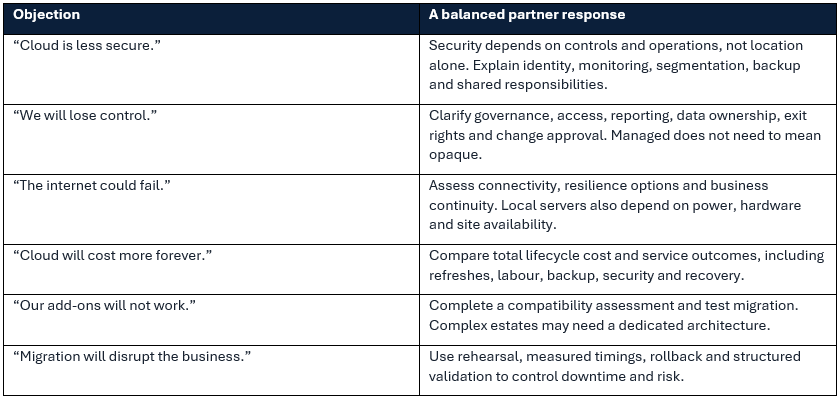
A well-managed cloud environment can give customers access to capabilities that would be difficult to operate consistently on individual premises: centralised identity controls, restricted administration, network segmentation, security logging, automated monitoring and resilient backup services. Large cloud platforms also invest heavily in the physical and foundational security of their infrastructure.
However, cloud security follows a shared-responsibility model. The platform provider secures the underlying cloud, while the customer and service provider remain responsible for identities, operating systems, applications, data, configuration and user behaviour to varying degrees. Moving an insecure configuration to cloud does not fix it. The partner proposition must include governance and ongoing management.
Does cloud make SAP Business One more flexible?
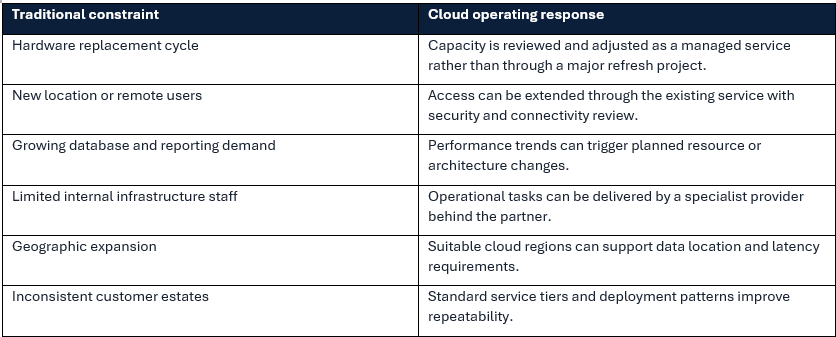
Cloud can make capacity, deployment and access more flexible because infrastructure is provisioned through services rather than purchased as a fixed hardware asset. Partners can build repeatable designs, add resources as workloads change and serve users across locations without treating every new office as a separate infrastructure project.
Flexibility still needs control. Unmanaged growth can increase cost, and ad hoc changes can create inconsistent estates. The best model uses standard service tiers, documented exceptions, monitoring and regular optimisation. This lets partners offer choice without creating a unique platform for every customer.
How does cloud support remote and distributed work?
Cloud-hosted SAP Business One can provide a consistent access point for users across offices, home locations and international operations, subject to network quality, security controls and application design. It reduces dependence on the customer’s physical premises and can simplify access for support teams and approved third parties.
The user experience still depends on latency, connection method, printing, file access and integration architecture. A specialist provider should consider where users and data are located, select an appropriate region and test real workflows. 'Accessible from anywhere' is only valuable when access is secure, responsive and supportable.
What are the scalability benefits for customers and partners?
For customers, cloud can reduce the need to predict infrastructure requirements years in advance. Capacity can be reviewed as database size, users, integrations and reporting demand change. For partners, a standardised platform allows new customers to be deployed through established designs and operating processes rather than bespoke hardware projects.
Is SAP Business One Cloud cheaper than on-premise?
Cloud should be compared on total service cost, not only the monthly infrastructure line. On-premise costs include hardware, warranties, power, facilities, backup equipment, security tools, licences, specialist labour, disaster-recovery arrangements and the risk of unplanned replacement. Cloud converts many of these elements into a recurring service, but poor design or unused capacity can still create waste.
The commercial advantage is often predictability rather than an absolute lowest price. Customers gain a clearer cost model and avoid large infrastructure events. Partners can package hosting, monitoring, backup, support and lifecycle management into a recurring proposition with defined inclusions and margin.
How does cloud create recurring revenue for partners?
A cloud service extends the partner relationship beyond software implementation and annual maintenance. The partner can provide an ongoing platform, monitoring, backup, recovery, security coordination, performance review and customer-success cadence. These services are valuable because they manage real operational risks, not because they simply re-bill infrastructure.
The model also creates more frequent customer contact. Capacity reviews, security discussions and service reports provide opportunities to understand growth, new sites, integrations and process changes. This can improve retention and uncover consulting demand, provided the service remains transparent and outcome-led.
What competitive advantage does a cloud proposition provide?
A credible cloud proposition allows the SAP Business One partner to control the modernisation conversation. Instead of waiting for a generic managed-service provider or another ERP vendor to challenge the customer’s infrastructure, the existing partner can offer a clear roadmap that preserves application knowledge and trusted relationships.
Channel alignment is important. Cloud4Partners operates exclusively for SAP Business One partners and provides white-labelled infrastructure and support. That allows the partner to remain customer-facing while drawing on AWS infrastructure and specialist operational capability behind the scenes.
What objections do customers raise, and how should partners answer?
When might on-premise or hybrid still be appropriate?
Cloud is not the right answer in every circumstance. A customer may have specialist local equipment, unreliable connectivity, strict operational constraints or an application dependency that cannot yet be moved. In those cases, on-premise or hybrid may remain appropriate while the partner addresses the constraint or modernises in stages.
An advisory approach builds trust. The goal is not to force every customer into the same model; it is to identify which risks cloud solves, which new responsibilities it creates and which architecture fits the business. Partners should document the decision rather than relying on assumptions about either cloud or local infrastructure.
How should partners build a cloud adoption plan?
1. Segment the installed base by infrastructure age, risk, complexity and customer readiness.
2. Define standard cloud service tiers and the exceptions that require bespoke design.
3. Create a clear financial model covering infrastructure, operations, support and margin.
4. Prepare customer-facing security, continuity, data-location and exit information.
5. Use a repeatable discovery and migration process rather than one-off projects.
6. Establish monitoring, reporting and service-review processes before scaling sales.
7. Train account teams to lead with business risk and outcomes, not cloud terminology.
8. Measure migration throughput, customer experience, recurring margin and support demand.
Why use a specialist SAP Business One cloud platform?
A hyperscaler supplies infrastructure services, but an SAP Business One partner still needs architecture, migration, monitoring, support and application-aware operations. Building that capability internally can be justified at scale, but it requires investment, 24/7 coverage, specialist skills and continuous improvement.
Cloud4Partners provides an AWS-based platform designed specifically for the SAP Business One channel, including multiple deployment models, partner support and the Migration Factory - a standardised, repeatable model for migrations and upgrades. For many partners, this offers a faster route to a mature cloud proposition while keeping ownership of the customer relationship.
Own the customer’s cloud journey
Cloud adoption is not only an infrastructure trend; it is a customer-retention and service-design decision. Partners that combine honest advice, repeatable migration and dependable operations can modernise their installed base while building recurring value. Speak with Cloud4Partners to assess your cloud proposition and identify the customers most ready to move.
Further Reading:
How to Choose the Right SAP Business One Hosting Partner
How to Migrate SAP Business One Customers to the Cloud without the Headaches
Why SAP Business One Partners are Outsourcing Infrastructure Management
Frequently asked questions
Is SAP Business One a cloud ERP?
SAP Business One can be delivered from cloud-hosted infrastructure, but the term covers different architectures and service models. Partners should explain whether the environment is shared, dedicated, managed and supported, rather than relying on the cloud label alone.
Can existing SAP Business One customers move to cloud?
Yes, subject to assessment of versions, databases, add-ons, integrations, users and connectivity. A test migration and controlled cutover plan are essential for complex estates.
Does SAP Business One Cloud work for international users?
It can, provided the architecture considers user locations, cloud region, latency, access method, data-location requirements and support coverage. Performance should be tested from representative locations.
Is AWS suitable for SAP Business One hosting?
AWS provides global infrastructure and a broad set of security, resilience and management capabilities. Suitability depends on using an architecture designed and operated for the specific SAP Business One workload.
How can a partner sell cloud without becoming an infrastructure company?
A partner can use a channel-only, white-label provider to supply the underlying platform and operational capability. The partner remains responsible for the proposition, customer relationship and SAP services while the provider operates behind the scenes.