
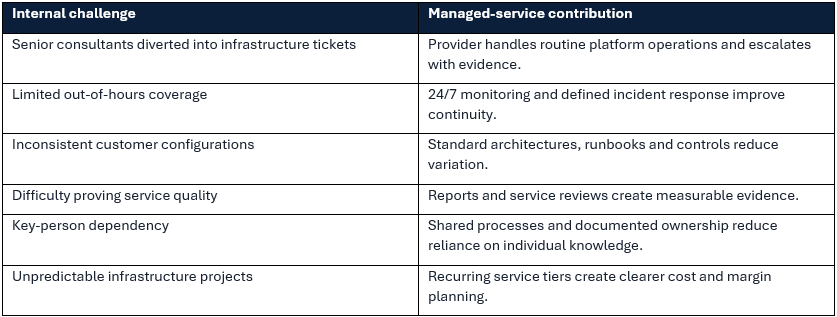
Infrastructure work rarely arrives in a convenient sequence. Alerts occur overnight, storage fills during reporting periods, certificates expire, backups fail and vulnerabilities appear while consultants are delivering customer projects. When the same small technical team owns every platform task, proactive work is repeatedly displaced by urgent tickets.
Outsourcing is not about abandoning technical responsibility. It is about choosing which capabilities create differentiation and which are better delivered through a specialist operating platform. The SAP partner should retain customer ownership, solution knowledge and governance while using a managed provider for repeatable infrastructure operations.
What are SAP Business One managed services?
SAP Business One managed services are the ongoing operational activities required to keep the hosting environment secure, available, recoverable and appropriately sized. They sit beneath application consulting and support but directly affect user experience and business continuity.
Infrastructure and service monitoring.
Incident detection, triage and escalation.
Operating-system and platform maintenance coordination.
Security tooling, logging and privileged-access controls.
Backup monitoring, retention and restore support.
Disaster-recovery planning and testing.
Capacity forecasting and performance optimisation.
Service reporting, governance and lifecycle planning.
A managed service should not be confused with a helpdesk that reacts after a customer reports a problem. Its purpose is to reduce the number and impact of incidents through visibility, standardisation and preventative action.
Why is 24/7 monitoring difficult to build internally?
True 24/7 monitoring requires more than an alerting tool. It needs meaningful thresholds, on-call coverage, documented runbooks, access controls, escalation paths and people capable of deciding whether an event is harmless, urgent or part of a wider incident. It also needs redundancy so service does not depend on one employee being available.
For many SAP Business One partners, the economics are challenging. The installed base may justify a professional managed service but not a complete operations centre. A specialist provider spreads platform investment and operational coverage across many environments while the partner maintains the customer-facing relationship.
What should proactive monitoring cover?
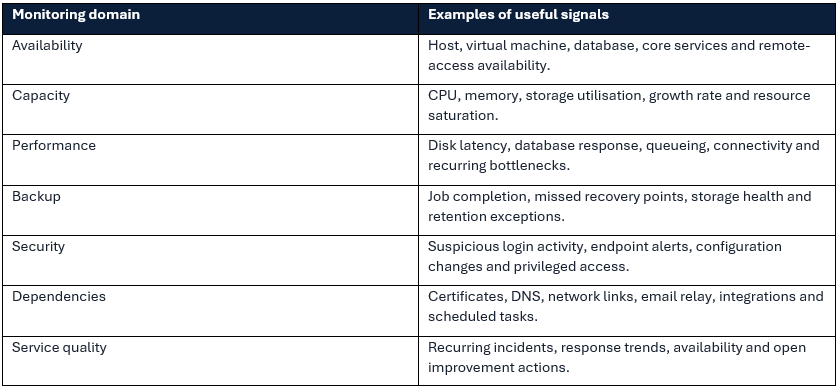 The objective is early action, not maximum alert volume. Poorly tuned systems create alert fatigue and teach teams to ignore noise. Monitoring should be adjusted to the environment, linked to a response procedure and reviewed as workloads change.
How should security be managed as an ongoing service?
Security is a lifecycle. Access that was appropriate during implementation may no longer be required; new vulnerabilities appear; users and suppliers change; and configuration drifts. Managed security therefore needs regular review, not a one-time hardening exercise.
Enforce strong identity controls and multi-factor authentication for privileged access.
Use least privilege and review administrative accounts regularly.
Segment environments and restrict management interfaces.
Maintain endpoint protection, logging and alert escalation.
Coordinate vulnerability remediation and operating-system maintenance.
Document incident roles, customer communication and evidence preservation.
Review controls against customer, industry and data-location requirements.
The provider should also explain the shared-responsibility model. Even on AWS or another major cloud platform, identities, guest operating systems, applications, data and configuration require active management. A managed service turns those responsibilities into named processes and evidence.
What role does patch management play?
Unpatched systems increase security and support risk, but indiscriminate patching can disrupt SAP Business One, databases, add-ons or integrations. Effective patch management balances urgency with compatibility and business availability. It includes assessment, prioritisation, testing where appropriate, maintenance scheduling, deployment evidence and rollback planning.
Responsibilities must be separated clearly. The infrastructure provider may manage operating-system maintenance, while the SAP partner coordinates application upgrades and add-on compatibility. A shared change calendar prevents each team from modifying the environment without understanding the impact on the other layers.
Why do backup and disaster recovery need active management?
Backup jobs can report success while the recovery process remains unproven. Files may be missing, retention may be insufficient, credentials may not be available during an incident or the restored environment may depend on services that were never protected. Active management monitors every backup cycle and periodically validates restoration against agreed recovery objectives.
Disaster recovery goes further by defining how a service is restored after major disruption. It requires architecture, runbooks, roles, communication, recovery sequencing and tests. Partners should be able to show customers not only that copies exist, but how the service would be recovered and who would lead the response.
How does capacity planning prevent customer problems?
SAP Business One workloads evolve. Databases grow, reporting expands, integrations generate new traffic and users adopt processes that were not part of the original sizing exercise. Without trend analysis, performance problems appear suddenly even though warning signs were visible for months.
Capacity planning reviews utilisation, growth and bottlenecks, then recommends changes before the customer is affected. It also protects margin by avoiding indiscriminate overprovisioning. The goal is not to keep every resource at the lowest possible usage; it is to maintain appropriate headroom and make changes based on evidence.
What does performance optimisation involve?
Performance should be diagnosed across the service chain. Slow SAP Business One response can originate in compute, storage, database configuration, network latency, user-session design, reporting, add-ons or integrations. A managed provider should identify the infrastructure evidence and work with the SAP partner when the cause sits in the application layer.
This collaborative boundary is important. Generic infrastructure teams may declare the server healthy because CPU usage is low, while application users remain slow. SAP-aware operations consider workload behaviour and understand when to involve database, application or add-on expertise.
How do managed services help partners scale?
Scaling an SAP Business One practice creates a choice: hire infrastructure specialists and build processes internally, or use a provider that already has the platform, tooling and coverage. Outsourcing can convert fixed operational investment into a service aligned with the number and complexity of customer environments.
What should white-labelled support look like?
White-labelled support should strengthen the SAP partner’s brand, not confuse the customer. The partner remains the trusted adviser and primary commercial relationship. The provider operates under agreed communication rules, uses approved terminology and avoids direct selling or account ownership.
The most effective model defines ticket routes, severity levels, escalation contacts, customer visibility and major-incident communications. Some partners prefer all contact to flow through their helpdesk; others allow controlled technical interaction. Either can work when responsibilities are explicit and the customer receives one coherent service.
How should partners evaluate a managed-services provider?
1. Confirm the provider is genuinely channel-aligned and will not compete for customers.
2. Assess SAP Business One knowledge, not only generic infrastructure certifications.
3. Review monitoring scope, on-call coverage, runbooks and escalation behaviour.
4. Understand exactly which maintenance, security, backup and recovery tasks are included.
5. Ask for service-report examples and evidence of restore or recovery testing.
6. Check how the provider handles changes, incidents and collaboration with add-on vendors.
7. Model the full commercial cost, including exceptions and out-of-scope work.
8. Review data ownership, exit assistance and the return or deletion of customer data.
When should infrastructure management stay in-house?
Keeping operations in-house can make sense when the partner has sufficient scale, mature processes, specialist staff and a strategic reason to own the platform. It may also be appropriate for a narrow set of highly specialised customer environments. The decision should be based on capability, resilience and economics rather than a desire to retain every technical task.
A blended model is common. The provider manages the cloud platform, backup, monitoring and infrastructure incidents, while the SAP partner owns application support, functional consulting, upgrades and customer success. This preserves differentiation where the partner creates the most value.
How can managed services improve customer success?
Reliable operations create the foundation for strategic conversations. When customers are not repeatedly dealing with capacity, backup or access failures, account reviews can focus on adoption, process improvement and business outcomes. Service data can also reveal changing needs: rapid growth, new locations, heavier reporting or increasing integration demand.
Cloud4Partners is designed to work exclusively through SAP Business One partners, providing AWS-based infrastructure, monitoring, support, backup, disaster recovery and white-labelled operational capability. This allows partners to extend their service without giving up the customer relationship or becoming a full-scale infrastructure operator.
Scale the service, not the overhead
The right managed-services model gives partners operational depth without weakening their customer position. It turns monitoring, security, recovery and capacity into a dependable service while freeing internal teams to deliver higher-value SAP work. Speak with Cloud4Partners to map the infrastructure tasks consuming your team and design a white-labelled operating model around your customers.
Further Reading:
How to Choose the Right SAP Business One Hosting Provider
How to Migrate SAP Business One Customers to the Cloud without the Headaches
Why More SAP Business One Partners are Moving Customers to the Cloud
Frequently asked questions
What is included in SAP Business One managed services?
The exact scope varies, but a complete service commonly includes monitoring, incident response, infrastructure maintenance, security controls, backup oversight, disaster-recovery support, capacity management and service reporting. Application consulting and functional support may remain with the SAP partner.
Does outsourcing infrastructure mean losing control?
No, provided governance is clear. The partner should retain visibility, approval rights, customer ownership and access to service evidence while the provider performs agreed operational tasks.
Can managed infrastructure support be white-labelled?
Yes. A channel-only provider can operate behind the SAP partner’s brand and communication model. Account protection, escalation and customer-contact rules should be documented contractually.
How do managed services reduce support workload?
They detect and resolve infrastructure issues earlier, standardise repetitive tasks and provide specialist escalation. This prevents SAP consultants from repeatedly diagnosing storage, operating-system, backup or connectivity problems.
Are managed services only for large SAP Business One partners?
No. Smaller and mid-sized partners may gain the greatest benefit because building 24/7 coverage and specialist operations internally is disproportionately expensive. The service should scale with the installed base and customer complexity.